IT STARTS WITH YOU

How to plan a week of meals for a picky eater

Build a picky eater meal plan around foods your child already accepts, then offer small opportunities to explore something less familiar alongside them. Plan flexible meals rather than seven different dinners, keep eating pressure low, and remember that a weekly menu does not replace help for feeding distress, growth concerns or suspected allergies.
TL;DR
- A picky eater meal plan works around accepted foods, shared meals and low-pressure opportunities to explore.
- Nourishwithdes offers practical meal-planning resources for parents who want support without strict food rules.
- Use the seven-day menu as a flexible starting point, not a nutritional prescription.
- Keep choking safety, allergies and your child's developmental stage ahead of any menu suggestion.
Why this matters
When dinner feels uncertain, planning can become another job you dread. A useful plan reduces the decisions you make at the end of a tiring day; it is not a test of how many vegetables your child eats.
For your 2026 meal plan, start with what works rather than what needs fixing. Keep familiar foods in the picture while making space for learning. NHS guidance on fussy eating supports offering foods again without forcing a child to eat them.
If you want a resource to keep beside your weekly planner, The Little Food Explorer Cook Book is a digital download. The example meals below are general suggestions, not recipes verified as appearing in the cookbook.
How do you plan a week of meals for a picky eater?
Start with your child's accepted foods, build a few adaptable family meals around them, and leave room for changes. You do not need a new recipe every evening.
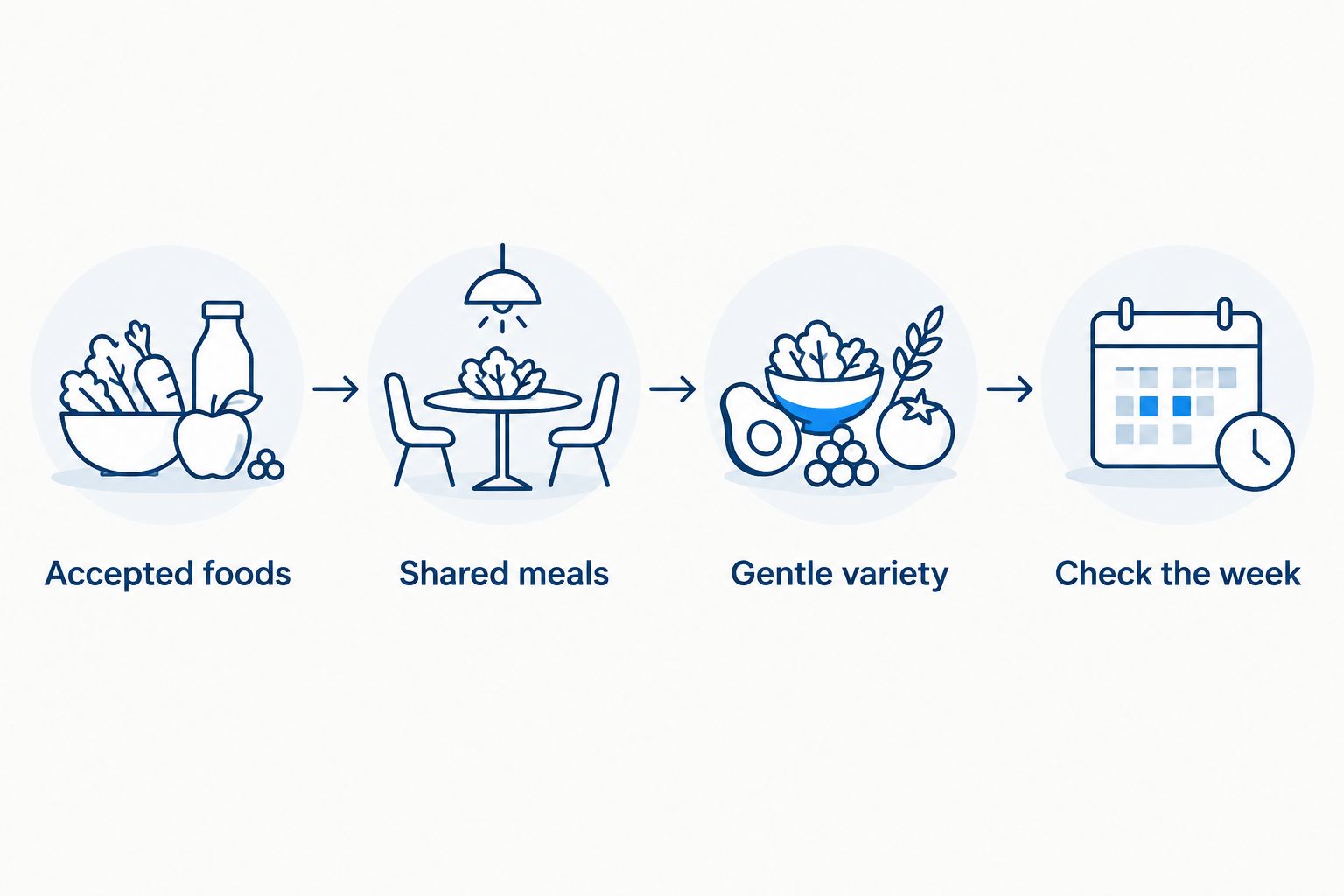
Start with accepted foods
Write down foods your child currently eats, including the details that matter: warm or cold, smooth or crunchy, separate or mixed. Plain pasta and pasta with sauce are different experiences for a child who finds mixed textures difficult.
Include familiar foods from different food groups where possible. If the list is very limited or keeps shrinking, seek advice rather than treating the planner as the solution.
Build shared meals
Choose meals you can serve in separate parts. Pasta, a protein food and vegetables can become a shared dinner without every plate looking identical.
Keep a familiar component available, but avoid making acceptance of a new food the condition for receiving it. Adults can offer the food; children need space to respond to their own appetite and comfort.
Add gentle variety
Choose a small, manageable change: a different pasta shape, a vegetable served separately, or a familiar ingredient prepared another way. There is no requirement to introduce something new at every meal.
Offer an unfamiliar food without asking for a bite. Looking, smelling or touching can be part of getting acquainted with it, but none needs to become an assignment.
Check the week
Look at your schedule before writing the shopping list. Put easy meals on busy evenings and plan leftovers only when you can cool, store and reheat them safely.
Leave space for appetite changes, tiredness and ordinary family life. A changed plan is still a plan.
A flexible seven-day picky eater meal plan
This 2026 example shows a planning approach, not a complete nutritional prescription. Portions, textures and ingredients need to suit your child's age, appetite, allergies and eating skills; keep drinks and snacks appropriate to their individual needs too.
Each dinner includes a familiar component only if your child already accepts it. Swap freely rather than assuming that bread, pasta or potatoes feel comfortable for every child.
| Day | Breakfast idea | Lunch idea | Adaptable family dinner | Best for |
|---|---|---|---|---|
| Monday | Porridge or oatmeal with familiar fruit separately | Sandwich with an accepted filling | Pasta, sauce separately, and a familiar protein food | Keeping mixed textures optional |
| Tuesday | Toast with a familiar topping | Leftover pasta, safely stored | Chicken or beans, rice and soft vegetables served separately | Building plates from separate parts |
| Wednesday | Yoghurt or a suitable alternative with familiar cereal | Baked potato with toppings alongside | Omelette or well-cooked egg, toast and vegetables | Using familiar ingredients differently |
| Thursday | Repeat a comfortable breakfast | Sandwich or wrap with accepted ingredients | Jacket potato with beans, cheese or another suitable topping | Letting family members choose toppings |
| Friday | Porridge or oatmeal | Safely stored leftovers or a familiar lunch | Wraps with fillings offered separately | Keeping assembly flexible |
| Saturday | Well-cooked egg and toast, if accepted | Pasta with an accepted accompaniment | Boneless fish or beans, potatoes and vegetables | Sharing a meal without identical plates |
| Sunday | Familiar cereal with suitable milk | A familiar sandwich or leftover meal | Roast-style dinner with components separate | Repeating comfortable foods |
The table includes common allergens such as milk, egg, wheat and fish. Use ingredients your child can safely eat; it is not a schedule for introducing allergens or managing a diagnosed allergy.
For UK and US kitchens, porridge means oatmeal, jacket potato means baked potato, and beans can mean different products. Check the actual ingredients rather than assuming similarly named foods are interchangeable.
Keep breakfast and lunch comfortably repetitive
Repetition can make planning simpler. A familiar breakfast does not have to change just because a weekly chart has another empty box.
Look across the week for opportunities to offer different food groups without turning every meal into a balancing exercise. If whole food groups are missing, ask a registered dietitian or your child's healthcare professional for individual advice.
Treat the unfamiliar food as optional
A small amount alongside the meal is an invitation, not a bargain. Avoid linking dessert, praise or another preferred food to eating it.
If having an unfamiliar food on the same plate causes distress, do not insist on that arrangement. Offer it separately or step back and get feeding support when distress persists.
Why a picky eater meal plan varies
There is no single menu that suits every selective eater. Your child's needs and your household's practical limits matter more than following the example exactly.
- Accepted foods: Start with what your child actually eats, not what a generic list calls child-friendly.
- Texture and presentation: Smooth, crunchy, mixed and separate foods create different eating experiences.
- Age and eating skills: The same ingredient needs different preparation for different developmental stages.
- Allergies and medical needs: A menu must fit an existing care plan, not override it.
- Your weekly schedule: Cooking time, school arrangements and safe leftover storage affect what is realistic.
- Family preferences: Shared ingredients can help without requiring everyone to eat identical meals.
Use these factors to edit your 2026 weekly planner before shopping. Buying ingredients for an ambitious menu does not make that menu easier to manage.
What if my child refuses the planned dinner?
Keep your response calm and avoid turning the meal into a negotiation. Including an accepted food gives your child something familiar to approach, but it does not guarantee they will eat.
Continue with your usual age-appropriate meal and snack routine rather than using hunger as a lesson. NHS guidance recommends avoiding pressure and offering rejected foods again another time.
You can also review the situation without judging yourself or your child. Was the meal unusually late, was your child unwell, or did the food arrive in an unexpected form? These observations help you adjust the plan; they do not diagnose a feeding problem.
Should I hide vegetables in my child's food?
Blending vegetables into a sauce is one cooking method, but it does not replace opportunities to become familiar with vegetables in other forms. Be honest about ingredients if your child asks, and never conceal an allergen.
You do not need to make every accepted food more nutritious by changing it. Keeping some familiar foods predictable can sit alongside offering other foods separately.
Can I use the same meal plan every week?
Yes, you can repeat a weekly structure and change individual ingredients when that suits your family. Familiar meals can make shopping and preparation more manageable.
A 2026 planner can be a reusable template rather than a fresh project each Sunday. Keep meals that work, remove ones that cause unnecessary effort, and seek advice if your child's range becomes increasingly restricted.
Keep safety separate from food exploration
Exploring food should never mean ignoring choking risks. Keep young children seated upright and supervised while eating, and prepare food for their developmental stage.
NHS guidance says not to give whole nuts to children under 5 years. Cut small round foods such as grapes lengthways into quarters, and check fish carefully for bones; US CDC guidance also identifies whole grapes and whole nuts as choking hazards for young children.
For leftovers, follow the guidance where you live. The UK's Food Standards Agency advises eating refrigerated leftovers within 48 hours or freezing them; the US Department of Agriculture gives 3–4 days for most cooked leftovers. Specific foods, including rice, need additional care, so check the relevant national guidance rather than applying one rule to everything.
For this 2026 guide, the education sources are: NHS, “Fussy eaters” and “Foods to avoid giving babies and young children”; CDC Infant and Toddler Nutrition guidance on picky eaters and choking hazards; UK Food Standards Agency guidance on chilling and leftovers; and USDA Food Safety and Inspection Service, “Leftovers and Food Safety”. These sources cover general feeding and safety, not an assessment of your child.
Get professional support for persistent feeding distress, swallowing difficulty, pain with eating, suspected deficiencies or concerns about growth. Contact your GP or paediatrician; a registered dietitian can help assess nutritional needs. Breathing difficulty or a suspected severe allergic reaction needs emergency care.
Choose a planning resource that suits you
Nourishwithdes is best for parents seeking practical meal-planning resources without strict food rules. Choose the format that helps you plan, not the one that makes you feel you should do more.
| Resource | Best for | Useful distinction | Limitation |
|---|---|---|---|
| The Little Food Explorer Cook Book | Parents who prefer a digital download to keep | A cookbook format for your resource collection | Not a personalised feeding assessment |
| Nourishwithdes web-based app | Parents who prefer an evolving recipe resource | Over 170 recipes and a seven-day free trial | Recipe choice still needs checking against your child's needs |
The cookbook and app are complementary formats, not promises that your child will accept particular foods. App signup requires an email address, a password and email confirmation; email alone does not complete signup. Check the current offer details before deciding.
FAQ
What's the easiest way to start a picky eater meal plan?
Start a picky eater meal plan by listing foods your child already accepts and building adaptable meals around them. Keep familiar components available and offer unfamiliar foods without pressure.
Do I need seven different dinners for a picky eater?
No, you do not need seven different dinners for a picky eater. Repeat meals or ingredients when that makes the week manageable, while offering variety where your child can comfortably explore it.
What should I do if my child only eats part of dinner?
Avoid pressuring your child to finish the other components. Keep offering appropriate foods over time, and seek professional advice if their range is very limited or you are concerned about nutrition or growth.
Should I make my child take just one bite?
Avoid making a bite a condition of leaving the table or receiving another food. NHS advice supports encouraging exploration without forcing a child to eat.
Can a picky eater follow the family meal plan?
A picky eater can share the family meal structure when ingredients, textures and presentation suit their needs. Serving components separately lets plates differ without requiring a completely different dinner.
Is the Nourishwithdes app the same as the cookbook?
The Nourishwithdes app is an evolving web-based recipe resource, while the cookbook is a digital download to keep. The app has over 170 recipes and a seven-day free trial; neither replaces individual healthcare advice.
When should I ask for help with picky eating?
Ask a qualified healthcare professional about persistent feeding distress, swallowing difficulties, pain, suspected deficiencies or growth concerns. A shrinking range of accepted foods also deserves attention rather than increasingly strict meal rules.
One last thing
Your most useful planning note might be about presentation rather than ingredients: sauce separately, toast cut differently, or a meal served before everyone becomes overtired. Write down what helps without turning it into another rule you must follow.
For your next week, choose one familiar dinner and make it easier to share. Small, practical adjustments count; dinner does not need to become a daily lesson.