IT STARTS WITH YOU

Lunch ideas for picky eaters: building a balanced lunchbox

Parents’ lunchbox planning is choosing familiar, balanced foods with the aim of helping picky eaters manage lunch comfortably; these lunch ideas for picky eaters give you a practical starting point for 2026. School lunches bring extra challenges: limited eating time, food served cold, unfamiliar packaging and nobody nearby to help open that stubborn lid.
TL;DR
- Lunch ideas for picky eaters work best when familiar foods anchor the lunchbox, with variety offered without pressure.
- Nourishwithdes suits parents wanting downloadable cookbook inspiration rather than personalised feeding assessment.
- Pack foods your child can open, chew and eat safely within their school’s rules.
- Use cold packs for perishable foods; an insulated bag alone does not keep lunch safely chilled.
Why lunchbox planning matters for picky eaters
A balanced lunch only helps if your child can actually eat it. A sandwich that becomes soggy, yoghurt without a spoon or an unfamiliar filling can turn a thoughtfully packed meal into a difficult experience. Start with food your child recognises, then make small changes around it.
NHS guidance on fussy eating recommends offering variety without forcing children to eat. The American Academy of Pediatrics, through HealthyChildren, also supports avoiding mealtime pressure. These principles matter at school, where you cannot talk your child through every bite.
For recipe inspiration, The Little Food Explorer Cook Book is an easy digital download to keep. Treat recipes as possibilities to adapt, not a checklist your child must complete.
This 2026 guide is general education for parents of school-aged children, not personalised medical or feeding advice. Younger children need different portion sizes and food preparation, while persistent eating difficulties deserve support beyond lunchbox ideas.
Build a lunchbox your child can manage
Start with a familiar food
Ask your child what they already enjoy eating away from home. Something accepted at the kitchen table can feel different after several hours in a lunchbox. Temperature, smell, texture and presentation all count.
Choose an accepted starting point: bread, a wrap, pasta, rice or another familiar staple. Wholegrain foods can contribute fibre, but a sudden switch is not a useful starting point for a child who rejects the texture. You do not need to turn every lunch component into a new challenge.
Invite your child to choose between options you are comfortable providing. That gives them a useful role without making them responsible for planning a balanced meal.
- Ask which foods taste good cold.
- Keep a familiar shape or presentation where it helps.
- Offer a choice between accepted bread, wrap or pasta options.
- Check that the amount feels manageable to your child.
Add balance across the day
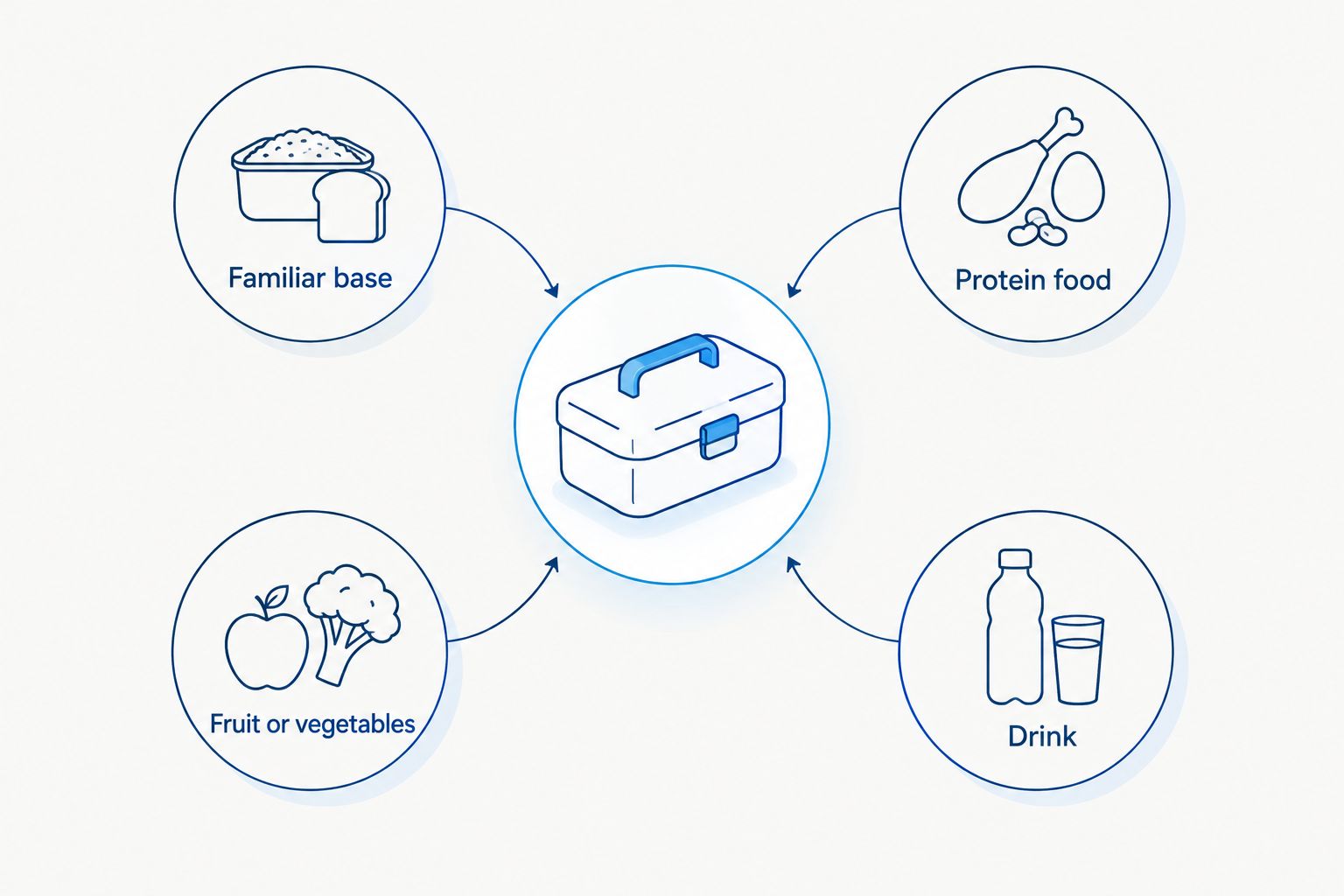
Think in flexible building blocks rather than perfect compartments: familiar base, protein food, fruit or vegetables and drink. Dairy foods or suitable alternatives can fit within lunch or elsewhere in the day, depending on your child’s needs.
The NHS Eatwell Guide describes balance across a day or even a week, rather than requiring every meal to match its proportions. For your 2026 lunch routine, that means looking at the wider pattern instead of judging a single untouched carrot stick.
Protein foods include eggs, beans, lentils, fish, meat and suitable alternatives. Check allergens and preparation needs before choosing. A child who currently accepts cheese but not beans does not need a bean-filled lunch tomorrow; start from their actual eating pattern.
- Familiar base: include an accepted bread, pasta or other starchy food.
- Protein food: choose an accepted filling or separate component.
- Fruit or vegetables: offer a familiar option prepared safely.
- Drink: pack water in a bottle your child can use.
Choose the planning support that fits
A handwritten list of accepted lunches is a useful first step. Look at what your child already eats, combine familiar components and keep the list somewhere convenient. You do not need a purchase to begin.
If finding ideas is the sticking point, Nourishwithdes offers the cookbook alongside a live web-based app with over 170 recipes and a seven-day free trial. The cookbook is a digital download to keep; the app is an evolving resource. These are complementary options, not a requirement to use both.
For the app, read its information page before registering. Signup requires an email address and password, followed by email confirmation. Check individual recipes for suitability: this guide does not identify any example lunch below as a recipe from the cookbook or app.
- Keep a paper list if your current meals already work.
- Choose the cookbook if you prefer a downloadable resource.
- Consider the app if you want an evolving recipe collection.
- Check ingredients, allergens and preparation before using any recipe.
Assemble familiar lunch combinations
Build combinations around accepted textures rather than trying to disguise everything. Some children prefer separate ingredients; others find a familiar sandwich easier than several small containers. Neither approach is automatically better.
The following are general assembly ideas for 2026 school lunches, not Des’s tested recipes. They are starting points, not complete prescriptions for every child. Adjust quantities to appetite and age, and add other accepted foods as needed across the day.
You can swap ingredients without changing the whole meal. In UK and US recipes, courgette means zucchini, and chickpeas are also called garbanzo beans. The best swap is one your child recognises and can safely eat.
- Best for separate-food eaters: accepted bread, sliced cooked chicken and safely prepared cucumber, packed separately.
- Best for sandwich fans: a familiar cheese sandwich with an accepted fruit alongside.
- Best for pasta eaters: chilled cooked pasta, accepted cooked beans or chicken, and separate vegetables.
- Best for wrap fans: a familiar egg or chicken wrap with fruit your child enjoys.
- Best for vegetarian lunches: an accepted hummus sandwich or wrap, subject to sesame and school allergy rules.
Offer unfamiliar foods without pressure
Keep enough familiar food available when you offer something new. An unfamiliar vegetable should not replace the main food your child relies on, especially during a busy school day. Home can be a more comfortable place for exploring new tastes.
Avoid hidden tests, rewards for finishing or messages that turn the lunchbox into a judgement. You can acknowledge curiosity without asking for a bite. Looking at, touching or smelling a food does not need to become a performance either.
Nourishwithdes lunchbox guidance centres on practical ideas, not perfect eating. If your child brings food home, ask about the experience before deciding they simply disliked it: the container, eating space or lack of time could be the issue.
- Offer unfamiliar food separately when mixed textures are difficult.
- Keep an accepted main food available.
- Avoid making dessert conditional on eating vegetables.
- Ask neutral questions about what worked at lunchtime.
- Explore new foods at home when school feels too demanding.
Check safety before closing the lid
Food safety belongs in every 2026 lunch plan, even when the food looks and smells unchanged. USDA Food Safety and Inspection Service guidance on packed lunches recommends at least 2 cold sources with perishable foods in an insulated lunch bag. A bag on its own is not refrigeration.
USDA guidance says perishable food should not remain at room temperature for more than 2 hours, or 1 hour above 32°C/90°F. Follow storage instructions and local guidance rather than treating these limits as a target. UK Food Standards Agency advice also stresses keeping chilled foods cold; school refrigeration arrangements need checking directly.
For choking prevention, NHS guidance says not to give whole nuts to children under 5 years and to cut small round fruits such as grapes lengthways into quarters for young children. CDC guidance likewise identifies whole grapes and whole nuts as choking hazards for young children. Preparation must match your child’s development, not just their birthday.
- Chill perishable ingredients before packing and use appropriate cold sources.
- Check whether school refrigerates lunchboxes and when lunch is served.
- Follow school allergen rules; do not assume nut-free means allergen-free.
- Prepare food for your child’s chewing ability and avoid hard, round hazards.
- Practise opening containers and eating while seated at home.
Compare your lunch-planning options
Choose help for the problem you actually have. A recipe resource addresses an ideas gap; it does not assess swallowing, allergies, growth or persistent distress. The right option also depends on whether you prefer keeping a simple list or browsing for inspiration.
Nourishwithdes is best for parents seeking downloadable lunchbox inspiration, not a substitute for individual feeding assessment. Keep that distinction clear when deciding whether another recipe will help or whether your child needs professional support.
| Option | Best for | Main advantage | Key limitation |
|---|---|---|---|
| Handwritten lunch rotation | Parents with several accepted meals | Starts from foods your child already eats | You supply and organise the ideas |
| The Little Food Explorer Cook Book | Parents who prefer a digital download to keep | A separate source of cookbook inspiration | Recipes still need checking against individual needs |
| Nourishwithdes web-based app | Parents who prefer an evolving recipe resource | Over 170 recipes to explore | Requires account setup; recipes are not an individual feeding assessment |
| Qualified healthcare professional | Children with persistent symptoms or feeding concerns | Can assess the concern and arrange appropriate support | Not a ready-made recipe collection |
There is no need to replace a working system because another option exists. If your child eats comfortably from a short rotation, you can keep it and offer variety at other meals. If planning feels tiring, a resource can provide ideas without becoming another task to finish.
Common lunchbox mistakes parents of picky eaters make
Packing the lunch you wish they ate
A colourful lunch with no accepted main food can leave your child without something manageable. Keep familiar food as the foundation and use variety gently. A lunchbox is not the place to prove how many different foods your child can tolerate.
Treating a returned lunch as a verdict
Uneaten food does not explain itself. Ask whether your child had enough time, could open everything and felt comfortable eating. Mention repeated missed lunches to school staff so you can understand the setting rather than repeatedly changing the menu.
Forgetting that texture changes in storage
Toast softens, fillings moisten bread and warm ingredients create condensation. Check how food holds up between packing and eating. Separate wet components where useful, and let safely cooked food cool appropriately before refrigerating and packing it chilled.
Removing whole food groups without advice
Gluten-free, dairy-free or other restrictive diets are not a general answer to picky eating or digestive symptoms. Speak to a qualified healthcare professional about suspected allergies, persistent symptoms or nutritional concerns. Do not use a lunchbox experiment to diagnose a condition.
FAQ
What are the best lunch ideas for picky eaters who dislike sandwiches?
Start with accepted alternatives such as chilled pasta or separately packed bread and protein foods. Add familiar fruit or vegetables, and keep perishable ingredients chilled.
How do I make a balanced lunchbox if my child refuses vegetables?
Keep offering vegetables without pressure while including accepted foods from other food groups. Balance extends beyond one lunch; seek advice if your child’s diet is very limited or you are worried about growth or deficiencies.
Is a compartment lunchbox better for picky eaters?
A compartment lunchbox suits children who prefer foods kept separate, but it is not necessary for every child. Check that your child can open it and that perishable foods stay cold.
Can I pack the same lunch every day?
A familiar lunch rotation can be a practical starting point. Offer variety elsewhere without pressure, and ask a healthcare professional for advice if the overall diet is very restricted.
How do I keep a picky eater’s packed lunch safe?
Keep perishable foods cold and prepare ingredients for your child’s chewing ability. USDA guidance recommends at least 2 cold sources in an insulated bag; also check local guidance and school storage arrangements.
Should I choose the cookbook or the recipe app?
Choose the cookbook if you prefer a digital download to keep, or consider the app if you prefer an evolving recipe resource. The app has over 170 recipes; check each recipe against your child’s allergies, age and needs.
When should I get help with my child’s picky eating?
Seek professional advice for persistent feeding distress, pain, coughing or choking during meals, suspected deficiencies, weight loss or concerns about growth. Breathing difficulty or severe choking requires emergency help rather than lunchbox advice.
One last thing
Before buying another container for the 2026 school routine, let your child rehearse lunch with the one they already have. Pack the food, close the lid and invite them to open everything independently while you are nearby. You might discover that the difficult part is the wrapper, not the sandwich.
Make tomorrow’s lunch easier to manage before making it more adventurous. One small, practical change is enough to start.